AWS Outposts Migration Security Considerations: Part 2
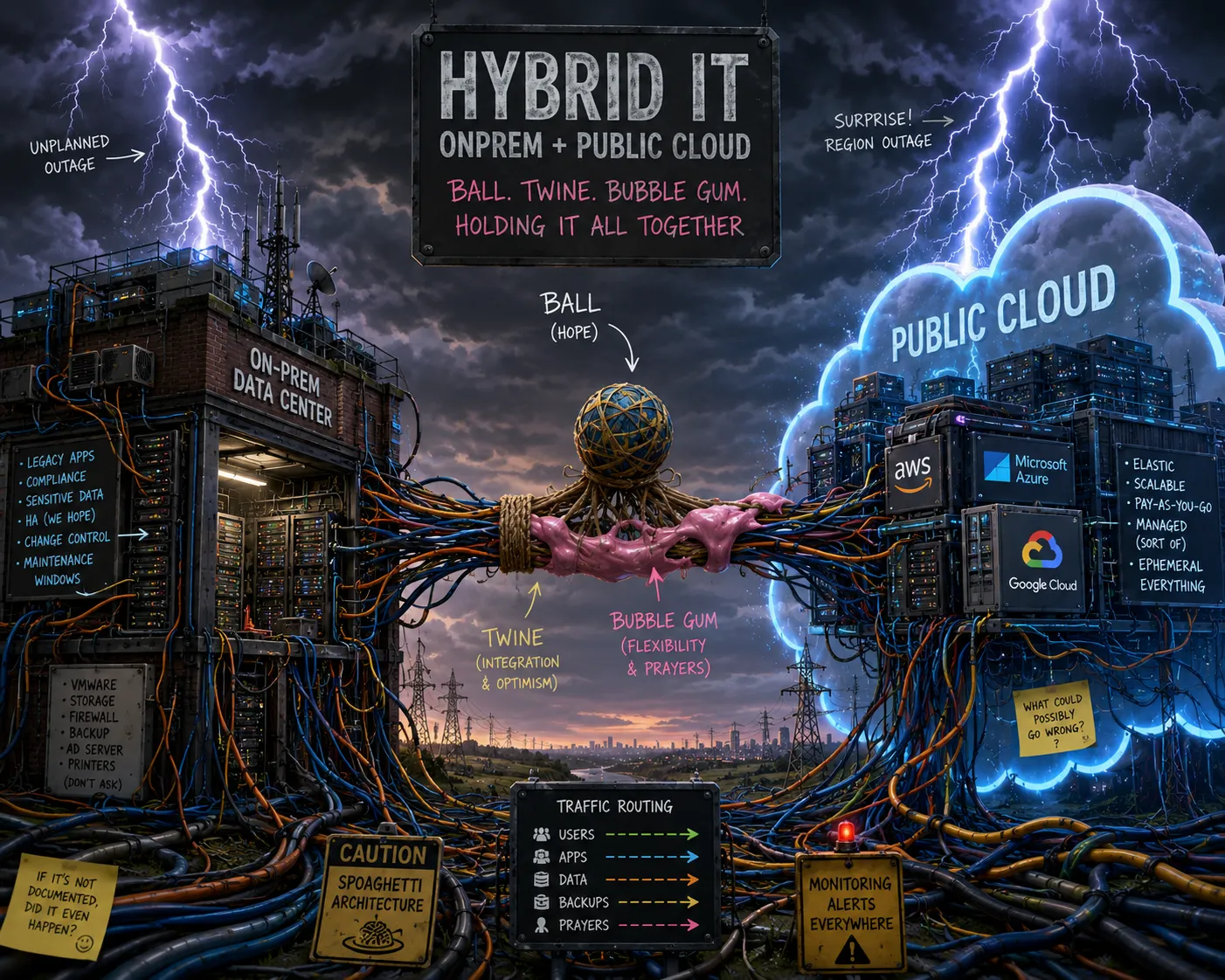
The most common reaction to that image has been, “WTF?” I decided to go with it and use the image as originally generated.
This post continues our discussion of AWS Outposts Migration Security Considerations. If you haven’t read Part 1, I recommend starting there.
Control Plane Dependency (Cloud Dependency Risk)
Outposts depends on connectivity back to AWS regions for:
- Management
- Updates
- Some service control logic
Risks
- If connectivity is degraded or intercepted, there may be potential disruption or delayed security updates
- Attackers may target the control plane link (e.g., MITM attempts, DNS manipulation, ARP spoofing )
- As noted above, the AWS Console & Management API are publicly accessible, which means your onprem solution’s control plan is internet-accessible. That’s a large difference from your traditional onprem model.
Mitigations & Controls
- Redundancy in physical network connections used by AWS Direct Connect.
- Properly secure a highly available architecture for your DNS infrastructure.
- Properly secure all network routers and other infrastructure equipment.
- Maintain Intrusion Prevention Systems (IPS) / Intrusion Detection Systems (IDS) systems that monitor your network.
- If an egress / forward web proxy is utilized for control plane communication (between AWS Outposts and AWS cloud-hosted control plane) ensure that the web proxy infrastructure is properly secured.
- Control plane communication (again, between AWS Outposts and AWS cloud-hosted control plane) is already TLS v1.2 or better. As long as certificate validation is not compromised, this goes a long-way to mitigating Man-In-The-Middle attacks.
Network Segmentation Drift
Your on-prem environment likely had:
- Rigid VLANs
- Firewalls you fully controlled
Ideally, it has a fully-deployed micro + macro segmentation model. If not, you may want to think about moving towards that.
Outposts introduces:
- Amazon Virtual Private Cloud constructs
- Security groups (stateful)
- NACLs (stateless)
Risks
These AWS networking services can introduce:
- Misconfigured security groups exposing internal services
- Flat networks emerging unintentionally
- Inconsistent policy enforcement between on-prem and cloud segments
Mitigations & Controls
- Start with a deny-by-default connectivity policy at every layer of network security controls both within AWS Outposts network segments and your onprem network segments.
- Only allow network connectivity that is required.
- If you are deploying microservices on top of a Kubernetes-based platform, consider using the full feature set of Istio (or other) Service Mesh that includes network connectivity policy, Mutual Auth SSL / TLS (MASSL) management, automated certificate rotation, workload traffic authentication, and other capabilities.
- Intentionally design the network your workloads execute within.
East-West Traffic Visibility Loss
In data center networking, “East-West Traffic” refers to communication between systems inside the same data center or environment. This could include server-server, microservice-microservice, VM-database, container-API style communication, or similar use case communication. In contract, “North-South Traffic” refers to communication entering or leaving the data center network (internet ingress / egress, VPN traffic, private WAN connections, etc).
Microservices love talking to each other, constantly. Hence, there is significant, “east-west traffic.”
On-prem you might (and, hopefully, do) have:
- Deep packet inspection firewalls
- IDS/IPS appliances
With Outposts:
- Traffic may stay inside VPC constructs
- Traditional tooling doesn’t always map cleanly
Risk
Risks include:
- Reduced visibility into lateral movement
- Harder detection of compromised services pivoting internally
Mitigations & Controls
- Utilize an IDS / IPS solution that can be deployed inside an AWS Outposts network. These solutions would generally come in the form of a virtual appliance.
- Palo Alto, Check Point, Cisco, and Fortinet all have some level of support for AWS Outposts.
- Extend other network monitoring solutions / capabilities into the AWS Outposts network. This may require adopting other / new vendors’ products.
Inconsistent Logging and Monitoring
Ideally, you have a central log aggregation solution that is pulling in all OS, application, and other logs from every node on the network. Likewise, you should have a SIEM solution deployed.
After you’ve deployed AWS Outposts, now, you’re juggling:
- On-prem log aggregation and SIEM tools
- AWS-native tools like:
Amazon CloudWatch
AWS CloudTrail
You may already have this problem if you have an AWS public cloud environment and onprem footprint (independent of our predating AWS Outposts adoption).
Risks
Risks include:
- Logs split across systems
- Missed correlation between events
- Gaps in audit trails
Attackers love environments where logs don’t line up.
Mitigations & Controls
- Plan for a global log aggregation platform where all log entries for all components of your environment end up that spans the public cloud, onprem, and AWS Outposts environments. This can become complex, but is very much worth it.
- Similarly, plan for a global SIEM solution where all interesting security related logs eventually end up that spans the public cloud, onprem, and AWS Outposts environments. Again, this can become complex.
- Have staff familiar with how to effectively use these tools.
- Include a transaction identifier in every log entry generated so that related log entries can be search for and found.
Patch and Vulnerability Management Gaps
For your onprem environment, hopefully, you’ve figured out regular and emergency patching processes. If this isn’t well-defined (and effective), it is strongly recommended to figure this part out before attempting to extend it to an AWS Outposts environment.
In an AWS Outposts environment:
- AWS patches the hardware layer
You patch:
- Guest OS
- Containers
- Microservices package dependencies
- Dev platform runtimes (node.js, .NET libraries, JDK, etc)
Risk
Risks include:
- Teams may assume “AWS handles it”, which leads to unpatched workloads.
- Drift between environments (nonprod vs prod vs Outposts).
Mitigations & Controls
- Understand roles and responsibilities between AWS and your organization when using AWS Outposts.
- Open a support ticket with AWS Support to confirm details that are not clear.
- Understand roles and responsibilities between teams within your own organization for the AWS Outposts environment.
- Develop and / or extend your patch management program to effectively accommodate AWS Outposts environments.
Supply Chain and Hardware Trust Concerns
This is subtle but important.
With a traditional onprem data center, model, your organization owns the hardware or has leased it and has full control over it.
With Outposts:
- Hardware is AWS-owned and managed
- Firmware and updates are controlled remotely
Risk
- Trust in AWS supply chain and update mechanisms
- Reduced ability to independently validate hardware integrity
This is not necessarily worse, but definitely different from on-prem sovereignty (the idea that an organization maintains direct control over its computing environment, data, operations, and governance by keeping systems on infrastructure it physically or administratively controls rather than relying fully on public cloud providers).
Mitigations & Controls
- If you are not prepared to accept this risk, you shouldn’t deploy AWS Outposts to your data center.
Data Residency and Leakage Paths
In the modern world, governments and organizations are beginning to care deeply about Data Sovereignty and Data Localization. See here to learn more about these concepts.
If you’re operating within a traditional onprem data center model, you have full control over the implementation of Data Localization.
Outposts is often used for data locality requirements, but:
- Some metadata and control data still flow back to AWS regions
- Misconfigured services can replicate data unintentionally
Risk
Risks include:
- Sensitive data leaving your premises without you realizing
- Compliance violations if improperly configured
Mitigations & Controls
- Only use public cloud regions that are within your legal geographic areas for storing data.
- Utilize a configuration management platform to ensure data replication settings are configured correctly and understand the global dataflow landscape.
- Don’t use AWS Outposts.
Secrets Management Weaknesses
A Microservices Architecture typically includes many secrets at every layer of the architecture (and all the various microservice nodes). If not managed properly, this tends to lead to:
- Secrets stored in clear text.
- Hard-coded secrets
- Environment variable leakage
- Poor rotation practices
Unless, you’re using something like:
- AWS Secrets Manager
- Hashicorp Vault
- CyberArk
If this isn’t being managed properly onprem before AWS Outposts is deployed, deploying AWS Outposts is only going to make the situation worse.
Risks
Risks include:
- Insecure & unmanageable secrets storage.
Mitigations & Controls
- Deploy a secure secrets management solution such as:
AWS Secrets Manager
Hashicorp Vault
CyberArk
- Be consistent in the secure secrets management solution that is used between onprem, pubic cloud, and AWS Outposts. Or, at least, as consistent as possible.
Hybrid Environment Complexity (The Real Killer)
The biggest risk isn’t one issue; it’s the complexity.
You now have:
- On-prem security controls
- AWS-native controls
- Integration glue between them
Risks
This can result in:
- Policy inconsistencies
- Misaligned trust zones
- Humans making mistakes trying to keep it all straight
Mitigations & Controls
- Automate as much as possible for all operational tasks.
- Test everything in non-production environments prior to moving to production environments.
Incident Response Becomes Harder
The complexity described in the last section can make security incident response more difficult in the event of a data breach.
In a breach scenario, incident response can be hindered by:
- Some logs are local; some are in AWS.
- Some controls are AWS-managed; some are managed by your organization.
Risks
Risks include:
- Slower containment
- Confusion over who can take what action
- Dependency on AWS support in certain scenarios
Mitigations & Controls
- Develop a disaster recover / business continuity strategy.
- Practice incident response exercises the way your organization would / should practice Disaster Recovery (DR) / Business Continuity (BC) exercises.
Summary
Moving to Outposts doesn’t reduce your attack surface — it reshapes it:
- You lose some physical control
- You gain API-driven risks
- You introduce hybrid complexity
The organizations that get burned are the ones that treat AWS Outposts like on-prem-with-better-hardware instead of AWS-inside-your-data-center.
If you want to do this safely Focus on:
- Strict IAM design (least privilege, short-lived credentials)
- Unified logging (central SIEM ingest from AWS + on-prem)
- Zero Trust networking concepts.
- Strong secrets management
- Clear shared Roles & Responsibilities ownership
Notes
- AI / GenAI / ChatGPT / etc were not used to generate the text of this article.
- ChatGPT was used to generate some of the images used.
- I used em dashes in my writing before the current GenAI wave was a thing. Not planning on changing now.
- Names have been changed to protect the guilty.
- None of the hostnames or users used in examples actually exist.
- Feel free to post any comments or suggestions below.
Originally published on Medium.