Introduction To Quantum Computing: Because Regular Computers Apparently Weren’t Complicated Enough
Disclaimer: I’m not a physicist. This is my attempt to understand quantum computing and the underlying physics, yet keeping it light. I do actually want my traditional audience to read this.
For decades, humanity looked at ordinary computers, which began with the Turing Machine in 1936, and thought, “You know what? These things make far too much sense.”
After all, conventional computers are built on a simple idea: bits. A bit is either a 0 or a 1. Light switch off; light switch on. Cat asleep; cat destroying furniture. Simple.
Then physicists arrived.
And as physicists often do, they discovered something deeply unsettling about reality and immediately decided to build a computer out of it.
Thus, the quantum computer was born.
The Classical Bit
Let’s begin with normal computers.
Your laptop, smartphone, gaming console, and probably your smart toaster all work using bits. Billions of tiny electronic switches flip between two states:
- 0
- 1
Everything you do from sending emails, watching videos, arguing with strangers on social media ultimately boils down to vast collections of these tiny yes/no decisions.
Elegant. Predictable. Understandable.
Naturally, quantum mechanics had other plans.
Enter the Qubit
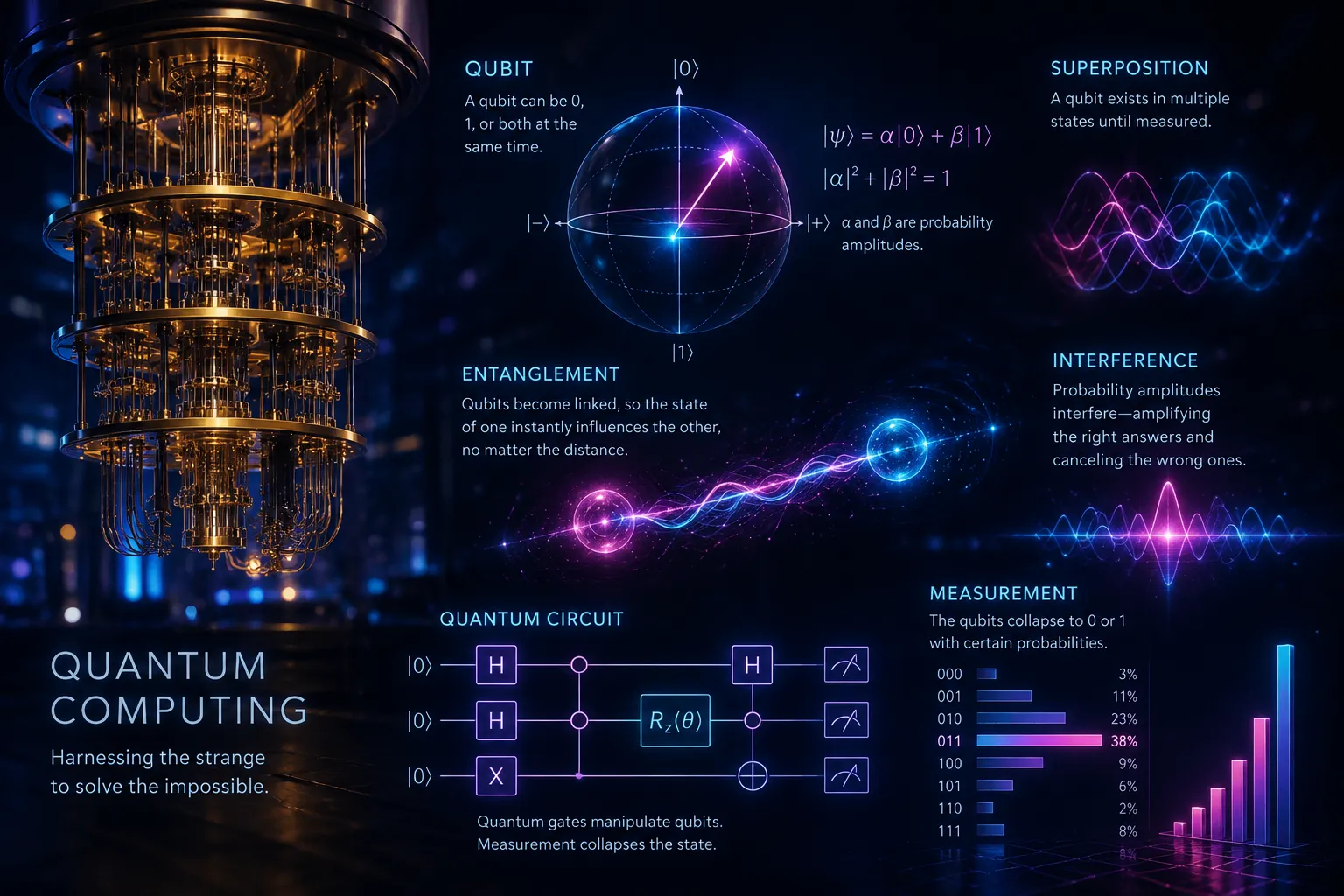
A quantum computer uses something called a qubit instead of a bit.
A normal bit is either 0 or 1.
A qubit can be:
- 0
- 1
- A mixture of both
At this point, many people’s eyes glaze over and they begin searching for a simpler hobby, such as astrophysics.
This strange property is called superposition.
Imagine a coin.
A normal computer sees either heads or tails.
A quantum computer looks at a spinning coin and says: “Why choose?”
The qubit exists in a combination of possibilities until it is measured.
Yes, this sounds ridiculous.
Nature agrees, but it doesn’t care.
The Universe’s Weirdest Parallel Processing Trick
People often hear that quantum computers “try all answers at once.”
This is not quite true. If it were, we’d already be using quantum computers to predict lottery numbers and locate missing socks.
Instead, quantum algorithms carefully manipulate probabilities.
Think of it like searching a gigantic maze.
A classical computer checks paths one at a time.
A quantum computer somehow convinces the maze to reveal which paths are promising and which are dead ends.
It isn’t brute force. It’s more like psychological manipulation directed at the laws of physics.
Entanglement: When Particles Become Gossip Partners
Now we reach the truly strange part.
Qubits can become “entangled”.
When two qubits are entangled, their states become linked.
Measure one, and you instantly gain information about the other.
No, they are not sending messages faster than light.
No, Einstein didn’t like this.
Yes, he famously called it “Spooky action at a distance.”
Which is remarkably professional language for a Nobel Prize-winning physicist saying_,_“What in the actual f**k is this?”
Entanglement allows quantum computers to coordinate calculations in ways ordinary computers simply cannot. It’s like having a team project where everyone actually knows what everyone else is doing. A scenario so unrealistic that it only exists in quantum mechanics.
Interference: Rigging the Probability Game
Superposition creates possibilities.
Entanglement links possibilities.
Interference is where the magic happens.
Quantum algorithms manipulate probability waves.
In these algorithms, helpful answers get amplified; wrong answers get canceled out (as they, damn well, should).
Imagine thousands of people shouting possible solutions.
A quantum algorithm somehow gives microphones to the smart people and muzzles for the idiots. By the end, the correct answer becomes much more likely to emerge when measured. It’s less “calculate everything” and more “convince reality to stop being difficult.”
Why Not Use Quantum Computers For Everything?
Because quantum computers are dramatic. Extremely dramatic.
A normal computer can survive being carried around in your backpack.
A quantum computer often requires:
- Temperatures colder than outer space (in the shadows where there is no heat energy)
- Complex shielding
- Exotic hardware
- Enough engineering talent to make rocket scientists nervous
The slightest disturbance can destroy quantum information through a process called decoherence.
In other words, quantum computers are the technological equivalent of a genius who refuses to work unless the room temperature, lighting, humidity, food & beverage options, and planetary alignment are exactly right. I’ve worked with people like this — you know who you are.
What Are They Actually Good At?
Quantum computers are not going to replace your laptop.
You won’t be browsing cat videos on a 10,000-qubit workstation anytime soon.
Instead, they excel at specialized problems such as:
- Factoring large numbers
- Simulating molecules
- Materials science
- Optimization problems
- Cryptography research
- Certain machine learning tasks
- Predicting the next pony race winner (just kidding)
Think of them as Formula 1 race cars.
Incredibly powerful. Astonishingly specialized. Completely impractical for grocery shopping.
The Catch
Building a useful quantum computer is one of the hardest engineering challenges humanity has ever attempted. Well, that and maintaining waffle structural cohesion in Fried Chicken n’ Waffles with all the fixins.
Quantum states are fragile. Errors are common. Error correction requires absurd numbers of physical qubits.
Many current quantum computers spend a substantial portion of their existence desperately trying not to forget what they were doing. Which, to be fair, makes them surprisingly relatable.
So, What Exactly Is the Quantum Processor Doing?
At this point you may be wondering, “Fine. The qubits are somehow both 0 and 1. The universe is clearly unsupervised. But what is the quantum CPU actually doing?”
An excellent question. Let’s compare it to a normal computer.
Suppose you’re trying to find a secret combination to a lock. A classical processor stores a bunch of bits in memory and then tries combinations one at a time:
0000000100100011...The processor reads memory, performs calculations, updates memory, and repeats. It’s methodical. It’s reliable. It’s the technological equivalent of checking every key on a giant keyring.
Now, imagine a quantum processor approaching the same problem.
Instead of storing one possible combination, it prepares a collection of qubits into a superposition representing many possible combinations simultaneously.
Four qubits don’t just represent:
0000They represent a probability distribution spread across:
0000000100100011...1111all at once.
This is where people usually conclude that quantum computers are checking all sixteen answers simultaneously.
Not quite.
That would be too straightforward. And, quantum mechanics strongly opposes straightforwardness.
Quantum Gates: Tiny Acts of Reality Manipulation
A classical processor performs operations like:
- AND
- OR
- NOT
- XOR
A quantum processor performs quantum gates. These gates don’t simply flip bits. Instead, they rotate probability amplitudes. Imagine you have sixteen possible solutions.
A quantum gate doesn’t ask “Is this answer correct?” Instead it asks_, “_How can I reshape the wave of possibilities so the correct answer becomes louder?” Every operation nudges the probability landscape. Wrong answers interfere with one another and begin canceling out. Useful answers reinforce each other.
The processor is less like a calculator and more like a conductor directing an orchestra composed entirely of uncertainty.
Wait, Where Is The Memory?
This is where things get weird again.
In a classical computer:
- RAM stores data
- CPU manipulates data
Nice and clean.
Quantum computers blur the distinction.
The qubits themselves are often both the memory and the thing being processed. Imagine if every byte in your RAM was also actively participating in the calculation. Not storing information. Being information. Performing information. Questioning the nature of information.
Basically every qubit is simultaneously a memory cell and a tiny physics experiment.
A More Concrete Example
Suppose we have three qubits.
Together they can represent eight possible states:
000001010011100101110111A classical machine searching for a special answer would check them individually.
A quantum machine begins by creating a superposition that spreads probability across all eight possibilities. Think of it as placing eight lottery tickets into a cosmic raffle drum. The processor then applies carefully designed quantum gates. These gates cause probability waves to collide.
Some combinations become stronger. Others become weaker.
After enough operations, the desired answer might look something like:
000 = 1%001 = 2%010 = 3%011 = 88% <---100 = 2%101 = 1%110 = 2%111 = 1%Now when you finally measure the qubits, the state “011” appears most of the time.
The processor never explicitly tested every answer.
Instead it manipulated the underlying probability waves so that reality became heavily biased toward revealing the correct one.
This is less like searching a database and more like convincing the universe to give you hints.
The Tragic Reality Of Measurement
Then comes the cruelest joke in quantum computing.
The moment you measure the qubits, the superposition collapses.
All that beautiful quantum weirdness disappears.
The machine effectively says_,_ “Congratulations. Here is your answer.”
And then immediately destroys the evidence of how it arrived there.
Imagine hiring the world’s greatest detective. They solve the case instantly. Then, burn all their notes, erase the security footage, and refuse to explain their reasoning.
That’s measurement in a quantum computer.
Error Correction Is Hard
Now imagine trying to preserve those fragile probability waves while:
- Electromagnetic noise exists
- Heat exists
- Vibrations exist
- The universe exists
Every interaction threatens to corrupt the calculation.
Engineers therefore use additional qubits to detect and correct errors.
In many modern designs, thousands of physical qubits may eventually be required to create a much smaller number of reliable logical qubits.
In other words, quantum computing’s current strategy for handling errors is remarkably similar to modern software engineering_, “_Add more complexity until the complexity starts behaving.”
Final Thoughts
Quantum computers are not magic.
They are not infinitely powerful.
They are not going to become sentient and overthrow civilization next Tuesday. AI will do that…
They are simply machines that exploit some of the strangest properties of reality ever discovered.
And that’s what makes them fascinating.
For centuries, humans have looked at the universe and asked_,_ “How does reality work?” Quantum mechanics answered_,_ “Poorly. Also, everything is simultaneously happening until you look.”
And somehow, humanity responded_,_ “Excellent. Let’s build a computer out of that.”
Notes
- AI / GenAI / ChatGPT / etc were not used to generate the text of this article.
- ChatGPT was used to generate the images.
- I used em dashes in my writing before the current GenAI wave was a thing. Not planning on changing now.
- Names have been changed to protect the guilty.
- None of the hostnames or users used in examples actually exist.
- Feel free to post any comments or suggestions below.
Originally published on Medium.