AES-256 and the Post-Quantum Panic: The Rare Cryptographic Algorithm That Isn’t Sweating
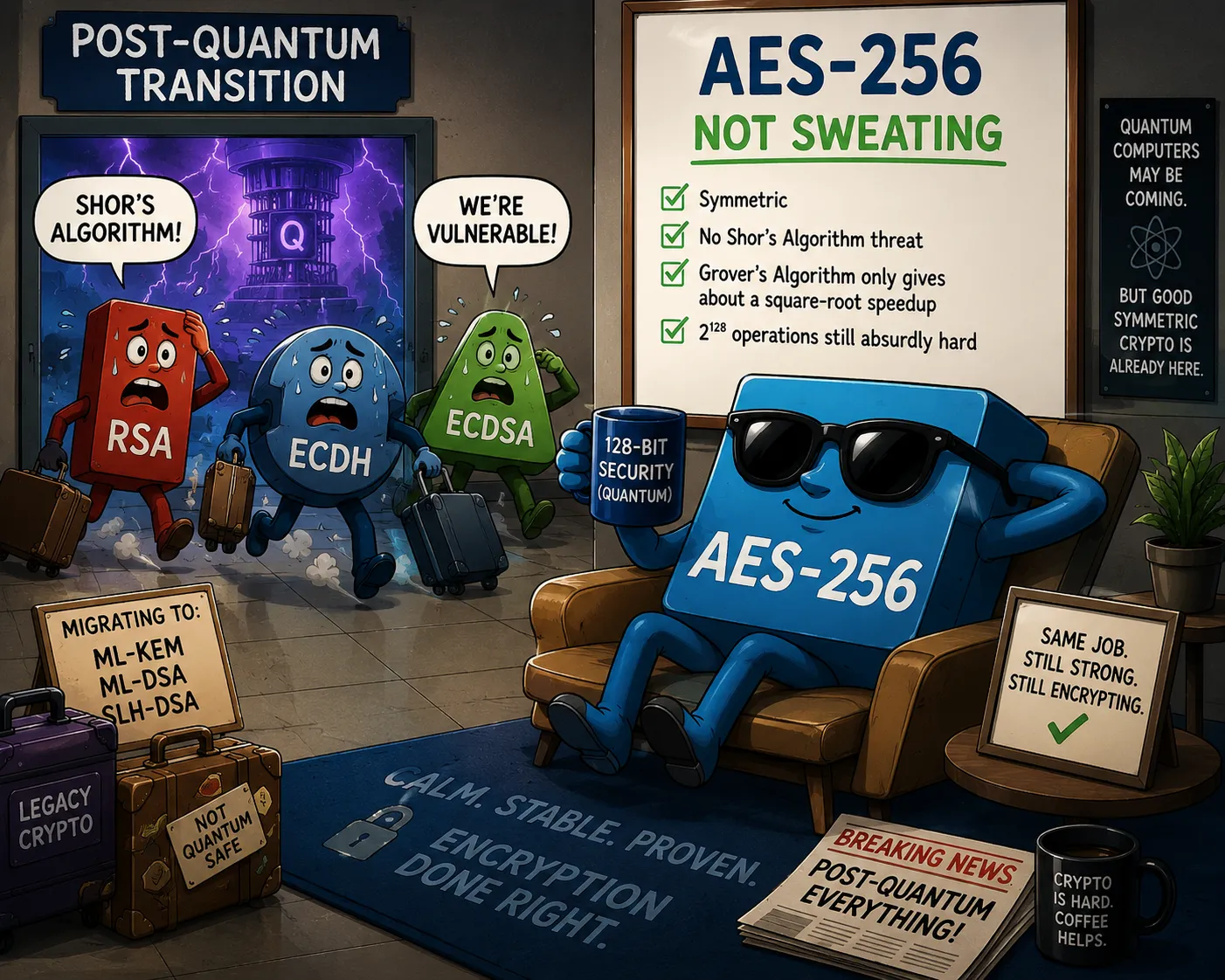
Quick Summary: AES-256 is the workhorse of enterprise data encryption at rest. It is not considered impacted by quantum computers or Post-Quantum Cryptography. It is considered quantum-resistant, which means it can withstand attacks from quantum computers / algorithms better than other encryption methods. A quantum computer only reduces the complexity of breaking AES-256 from ²⁵⁶ operations to ¹²⁸ operations — that’s still a big number.
The cybersecurity industry is currently experiencing what can best be described as a controlled panic.
- Governments are issuing guidance.
- Vendors are publishing migration roadmaps.
- Security architects are attending webinars they secretly wish were emails.
- Everyone is talking about post-quantum cryptography.
And, for good reason.
Quantum computers threaten to break some of the most important cryptographic systems ever deployed.
RSA? In trouble.
Diffie-Hellman? Also, in trouble.
Elliptic Curve Cryptography? Not having a great time either.
Meanwhile, AES-256 is sitting quietly in the corner sipping coffee. You can read what NIST had to say about it here.
The Quantum Apocalypse
For decades, public-key cryptography has relied on certain mathematical problems being extremely difficult.
- RSA relies on factoring large numbers.
- Diffie-Hellman relies on discrete logarithms.
- Elliptic Curve Cryptography relies on elliptic curve discrete logarithms.
Then, quantum computing showed up carrying something called Shor’s Algorithm.
Shor’s Algorithm is essentially a mathematical wrecking ball aimed directly at these assumptions.
A sufficiently powerful quantum computer could solve these problems dramatically faster than classical computers, which is unfortunate if your entire security model depends on them remaining difficult.
This has the cryptographic community and the
Why AES Is Different
AES is not a public-key algorithm.
AES is a symmetric cipher. In other words, were talking the use of a symmetric key versus asymmetric key usage. This means both sides already possess the same secret key.
AES doesn’t need to solve difficult mathematical problems to establish trust.
It simply takes a key and uses it to encrypt data.
Think of RSA and Diffie-Hellman as the people figuring out how to exchange a secret, which is a hard problem.
AES is the armored truck that carries the secret once everyone already agrees on it.
The armored truck isn’t the problem; the key exchange is.
Meet Grover’s Algorithm
This is the part where people usually say_,“Wait, I thought quantum computers broke everything.”_
Well, not quite.
Quantum computers have another famous algorithm called Grover’s Algorithm.
Grover Explaining The Number Two (All Relevant Copyright Attributions)
Unlike Shor’s Algorithm, Grover doesn’t completely destroy AES. Instead, it speeds up brute-force searching. That’s still important, but it’s a very different kind of threat.
Note, I personally added the Sesame Street reference to Grover counting. That isn’t an AI hallucination. Trying to keep it light; I chuckle every time I see that. On the count of three, everyone count to two.
The Good News
Imagine a key space containing 2¹²⁸ possible keys. A classical computer might need to search roughly 2¹²⁸ possibilities. Note, medium.com seems to have added a new superscript feature recently. But, as I got back to continue editing and pages reload, it is getting mangled. As I type this, the “2” does correctly have a superscript “128”. We’ll see how long that lasts.
Grover’s Algorithm reduces this to approximately 2⁶⁴ operations. That’s a huge improvement from an attacker’s point of view.
For AES-128, it’s enough to make cryptographers somewhat uncomfortable.
For AES-256, however, 2²⁵⁶ becomes approximately 2¹²⁸ under Grover’s Algorithm. And, 2¹²⁸ operations is still completely absurd as of Q2, 2026.
To put this in perspective the phrase “astronomically large” stops being useful at this scale. The universe simply runs out of time before you run out of keys.
Why AES-256 Was Already Playing Chess
Long before post-quantum cryptography became fashionable, many organizations were already deploying AES-256. Partly because more bits sound better, which, surprisingly, is not terrible cryptographic reasoning in this particular case.
AES-256 effectively doubles the key size compared to AES-128. That extra margin becomes incredibly useful in a post-quantum world.
It’s as if AES-256 spent the last twenty years quietly preparing for an exam everyone else forgot was coming.
The Funny Part About Post-Quantum TLS
A lot of people hear that quantum computers threaten encryption. Then, they imagine every encryption algorithm being replaced simultaneously.
That’s not actually what’s happening.
Consider a traditional TLS connection.
Historically it might look something like:
ECDHE ↓Shared Secret ↓AES-256-GCMThe vulnerable component is ECDHE. Not, AES-256-GCM.
The encrypted data remains protected by AES.
The problem is how the AES key was established.
In post-quantum TLS, the architecture becomes:
ML-KEM ↓Shared Secret ↓AES-256-GCMNotice, AES didn’t move, change, or even have to attend the migration meeting.
I talk more about the impacts of Post-Quantum Cryptography on TLS in my “Post-Quantum Cryptography (2026): Preparing for the End of RSA and ECC” blog post.
NIST Isn’t Replacing AES
The National Institute of Standards and Technology spent years evaluating post-quantum cryptography.
The resulting standards include:
- ML-KEM
- ML-DSA
- SLH-DSA
You’ll notice something missing.
There is no replacement for AES.
- No “Super Quantum AES.”
- No “Ultra AES 9000.”
- No “AES But More Quantum.”
Because nobody currently needs one.
The threat model simply doesn’t justify replacing AES-256.
The Reality Of Security Engineering
Security professionals occasionally dream of replacing every old technology with something new and exciting.
Reality usually responds with some version of how about we keep the parts that still work?
AES-256 remains one of the most thoroughly analyzed cryptographic algorithms ever created.
It has survived:
- Academic scrutiny
- Government scrutiny
- Industry scrutiny
- Countless attempts at cryptanalysis
And, even after quantum computing entered the conversation, AES-256 remained largely intact. That’s a remarkably impressive track record.
Could This Change?
Of course.
Cryptography is a field where people receive awards for discovering everyone else was wrong.
- A future breakthrough could alter the landscape.
- A new quantum algorithm could be discovered.
- A new cryptanalytic technique could emerge.
Nobody gets guarantees in cryptography; only, confidence levels.
But, based on current knowledge, AES-256 remains one of the safest bets in modern cybersecurity.
Summary
The post-quantum transition is absolutely real.
Organizations need to replace vulnerable public-key algorithms.
TLS stacks need updates.
PKI systems need modernization.
Identity platforms need migration plans.
But, despite all the excitement, AES-256 is not the algorithm keeping cryptographers awake at night.
If RSA and Diffie-Hellman are frantically packing their bags for the post-quantum migration, AES-256 is standing on the porch watching them leave (hugs and kisses).
Not because it’s invincible. Not because it doesn’t care, but because, unlike many of its neighbors, it was already carrying enough security margin to survive the quantum storm.
And, in cryptography, that’s about as close to a victory lap as anyone gets.
In the next major break through / down, AES-256 will probably be the one forcing algorithm changes, key size increases, and / or software upgrades.
Notes
- AI / GenAI / ChatGPT / etc were not used to generate the text of this article.
- ChatGPT was used to generate the images.
- I used em dashes in my writing before the current GenAI wave was a thing. Not planning on changing now.
- Names have been changed to protect the guilty.
- None of the hostnames or users used in examples actually exist.
- Feel free to post any comments or suggestions below.
Originally published on Medium.