Data Classification Best Practices: Knowing What Matters Before It Walks Out the Door
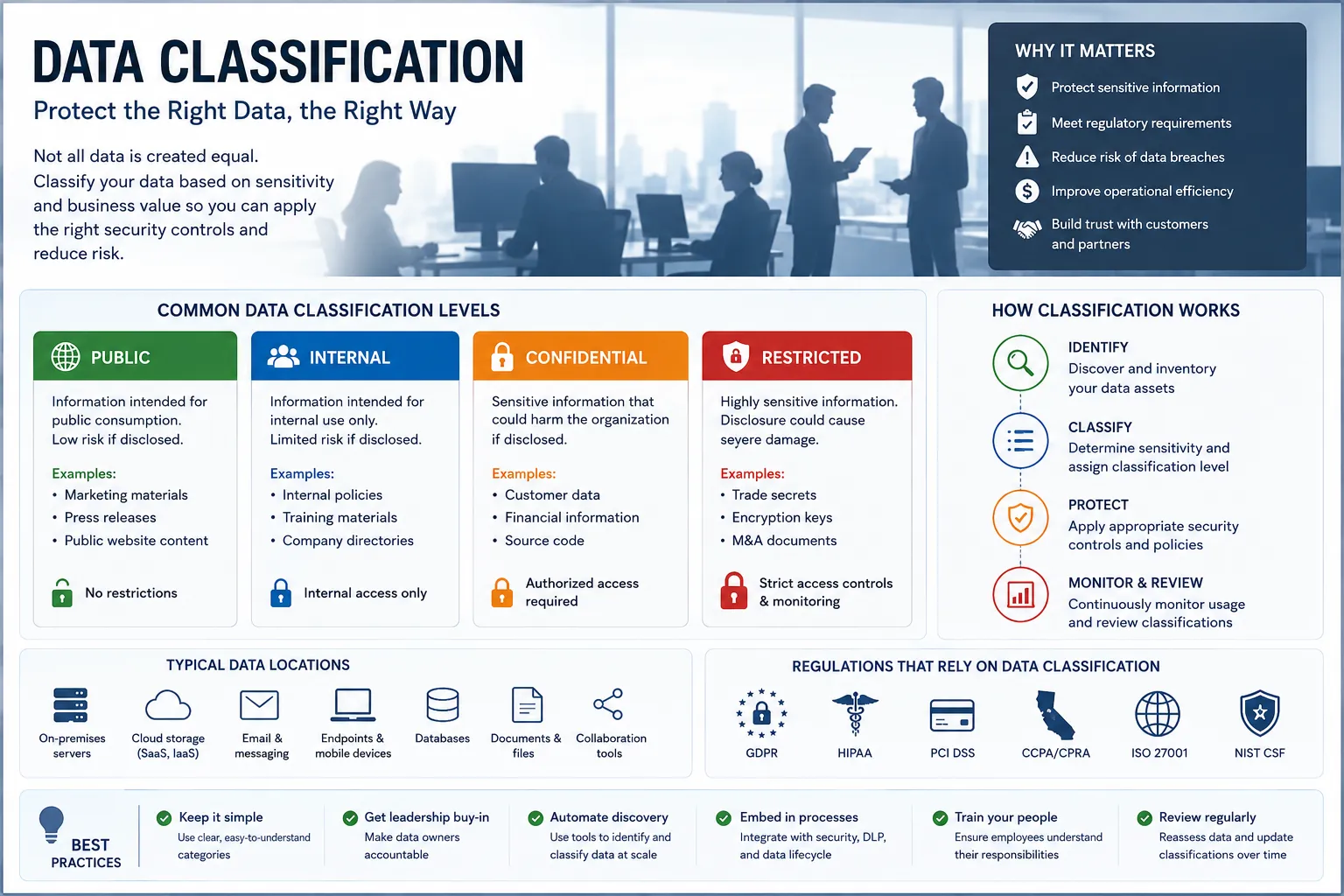
Organizations spend millions of dollars protecting data, yet many struggle to answer a surprisingly simple question:
Which data is actually important?
Without understanding the value and sensitivity of information, security controls become little more than expensive guesswork. Data classification provides the foundation upon which effective cybersecurity, privacy, governance, and compliance programs are built.
If you don’t know what data you have, you can’t effectively protect it.
While we are at it, let’s also include data owners and data description as part of the data we’re trying to gather because the data classification is bordering on useless without a concrete understanding of what it is and who owns it.
To be clear, most every organization has a documented policy that data classification must be defined, many do not have the discipline or political will to follow through or maintain it after some initial effort.
What Is Data Classification?
Data classification is the process of categorizing information based on its sensitivity, business value, regulatory requirements, and potential impact if disclosed, altered, or destroyed. It is a required component of almost every major data privacy / protection regulation and framework.
The objective is to apply security controls appropriate to the level of risk associated with the data.
Rather than treating every file, database (table, column?), email, and document equally, organizations classify data into categories that guide how information should be stored, transmitted, accessed, and retained.
Data classification serves as the foundation for numerous security initiatives, including:
- Data Loss Prevention (DLP)
- Access Control (Authentication + Authorization)
- Encryption
- Incident Response
- Data Retention
- Regulatory Compliance
- Artificial Intelligence Governance
Common Data Classification Levels
Organizations may use different terminology, but most classification schemes follow a similar model.
Your organization may tailor this model to match its needs.
Public
Public information is intended for unrestricted distribution.
Examples include:
- Marketing materials
- Public website content
- Press releases
- Published financial reports
Unauthorized disclosure typically poses little or no risk.
Internal
Internal data is intended for employees and authorized contractors but is not highly sensitive.
Examples include:
- Internal policies
- Organizational charts
- Project documentation
- Internal training materials
While disclosure may not be catastrophic, it could still create business or reputational concerns.
Confidential
Confidential information could cause harm if disclosed to unauthorized individuals.
Examples include:
- Customer information
- Employee records
- Financial data
- Vendor contracts
- Source code
- Product roadmaps
This category often represents the majority of information organizations seek to protect.
Restricted or Highly Confidential
This represents an organization’s most sensitive information.
Examples include:
- Trade secrets
- Encryption keys
- Mergers and acquisitions data
- Sensitive legal communications
- Critical infrastructure information
- Security architecture documentation
Unauthorized disclosure could result in significant financial, legal, operational, or reputational damage.
Why You Need Data Classification
Many organizations focus on security technologies without first understanding what data they are protecting.
This frequently leads to:
- Overprotecting low-value information
- Under-protecting critical assets
- Excessive compliance costs
- Poor incident response prioritization
A well-designed classification program helps organizations:
- Prioritize security investments
- Reduce risk
- Improve compliance efforts
- Strengthen data governance
- Enable effective DLP controls
- Support AI governance initiatives
Data classification transforms security from a technology problem into a business risk management process.
Regulations That Require Data Classification
Many regulations and frameworks either explicitly require data classification or strongly imply it through control requirements.
This is hardly an exhaustive list.
I go into more detail about data privacy regulations in other posts.
GDPR
The European Union’s General Data Protection Regulation requires organizations to implement controls appropriate to the sensitivity of personal data.
While GDPR does not prescribe specific classification labels, organizations must identify and protect personal information according to risk.
Examples include:
- Financial information
- Sensitive personal data
- Health-related information
Without classification, it becomes difficult to demonstrate compliance.
HIPAA
Healthcare organizations subject to HIPAA must identify and protect Protected Health Information (PHI).
Examples include:
- Medical records
- Treatment information
- Insurance information
- Patient identifiers
Proper classification helps ensure PHI receives appropriate protections.
PCI DSS
Organizations processing payment card information must identify and protect cardholder data.
Examples include:
- Credit card numbers
- Authentication data
- Payment transaction information
Data classification helps define the scope of PCI compliance efforts and reduces unnecessary compliance costs.
CCPA and CPRA
California privacy regulations require organizations to understand what personal information they collect and how it is used.
Effective classification supports:
- Data inventories
- Consumer rights requests
- Retention requirements
- Privacy impact assessments
NIST Cybersecurity Framework
The NIST Cybersecurity Framework emphasizes asset management and data governance practices that rely heavily on data classification.
Organizations cannot effectively protect information they have not identified and categorized.
ISO 27001
ISO 27001 explicitly recommends information classification as part of an organization’s Information Security Management System (ISMS).
Classification helps determine:
- Access controls
- Handling procedures
- Retention requirements
- Security controls
Emerging AI Regulations
As organizations deploy AI systems, regulators increasingly expect visibility into the types of data being used for:
- Model training
- Retrieval-Augmented Generation (RAG)
- Fine-tuning
- Inference
Sensitive data classifications are becoming critical components of AI governance programs.
Data Classification Best Practices
Start with Simplicity
One of the most common mistakes is creating too many classification levels. A simple four-tier model is often sufficient:
- Public
- Internal
- Confidential
- Restricted
If users cannot easily understand the categories, adoption will suffer.
Define Clear Ownership
Every classification program should establish data ownership.
Data owners should be responsible for:
- Classification decisions
- Access approvals
- Retention requirements
- Risk acceptance
Without ownership, classification quickly becomes inconsistent.
Classify Data Where It Is Created
Classification should occur as early as possible.
This may include:
- Document creation
- Database onboarding
- Application development
- AI knowledge base ingestion
The earlier data is classified, the easier it is to apply controls consistently.
Automate Where Possible
Manual classification does not scale.
Modern tools can automatically identify:
- PII
- PHI
- Credit card data
- Source code
- Intellectual property
Automation reduces human error while improving consistency.
Integrate Classification with Security Controls
Classification should directly influence:
- Encryption policies
- Access control policies
- DLP rules
- Monitoring requirements
- Retention schedules
Classification without enforcement provides little value.
Regularly Review Classifications
Information changes over time.
A project roadmap may eventually become public.
An acquisition plan may become irrelevant after a transaction closes.
Organizations should periodically review and update classifications.
Data Classification and AI
The rise of generative AI has made data classification more important than ever.
Employees routinely interact with:
- Public AI platforms
- Internal AI assistants
- RAG systems
- Fine-tuned language models
Without classification, organizations risk exposing sensitive information to systems that were never intended to process it.
Classification can help organizations determine:
- Which data may be used for AI training?
- Which data may be indexed for retrieval?
- Which data must never leave controlled environments?
- Which prompts should be blocked by DLP systems?
As AI adoption accelerates, data classification is increasingly becoming a prerequisite for responsible AI governance.
Conclusion
Data classification is one of the most fundamental capabilities in cybersecurity, privacy, and governance. Organizations cannot effectively protect information they do not understand.
A well-designed classification program provides the foundation for security controls, regulatory compliance, risk management, and AI governance. By identifying what data exists, how sensitive it is, and who is responsible for it, organizations can focus their resources where they matter most.
In an era of cloud computing, remote work, and artificial intelligence, data classification is no longer just a compliance exercise — it is a business necessity.
Notes
- AI / GenAI / ChatGPT / etc were not used to generate the text of this article.
- ChatGPT was used to generate the images.
- I used em dashes in my writing before the current GenAI wave was a thing. Not planning on changing now.
- Names have been changed to protect the guilty.
- None of the hostnames or users used in examples actually exist.
- Feel free to post any comments or suggestions below.
Originally published on Medium.